Injectable Collagen Update 2026: Types, Brands, Benefits, and Which Is Better?
Injectable collagen, commonly referred to as “Live Collagen” or Kollagen Sod (คอลลาเจนสด) in Thailand, has become an increasingly popular topic in aesthetic medicine, particularly for addressing thin skin, fine lines, wrinkles, and age-related changes in skin firmness.
In 2026, injectable collagen is no longer limited to a single type of product. Several formulations are available in Thailand, including animal-derived collagen and collagen proteins produced using recombinant biotechnology.
These products differ in their origins, molecular structures, ingredients, manufacturing processes, and intended applications.
In this article, REVA Clinic explores the latest developments in injectable collagen in 2026, how different types compare, what happens after collagen is injected into the skin, and which skin concerns may benefit from treatment.
What Is Injectable Collagen?
Injectable collagen refers to products containing collagen proteins or collagen-derived materials designed for injection into the skin or soft tissues.
Collagen is a major structural component of the skin's extracellular matrix (ECM). It helps maintain skin strength, firmness, and structural integrity.
As we age, collagen production decreases, while changes in existing collagen fibers contribute to wrinkles, reduced elasticity, and thinner-looking skin.
However, not all injectable collagen products are identical.
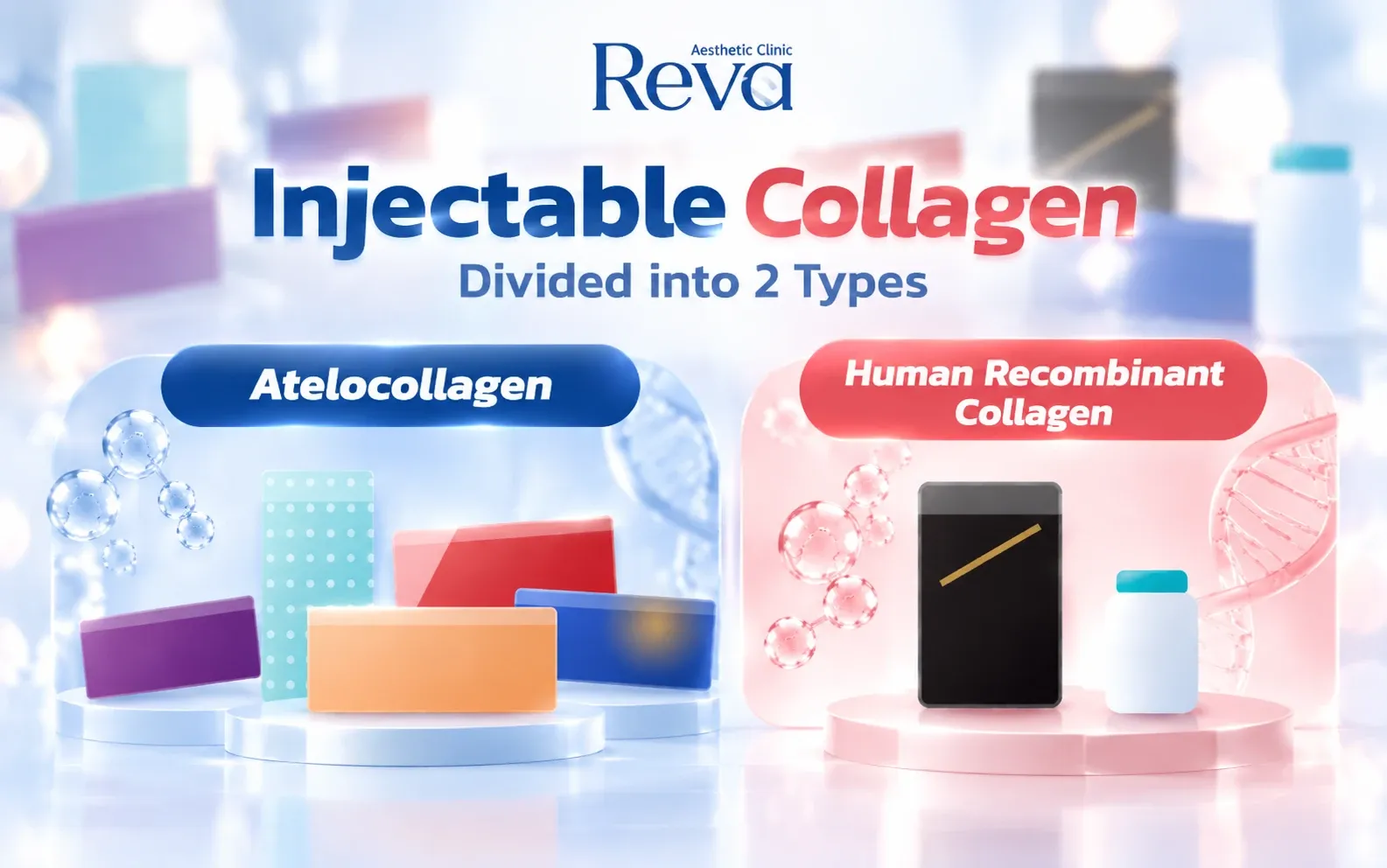
In 2026, injectable collagen products can be broadly divided into two main categories based on their origins and manufacturing methods:
Animal-derived Atelocollagen
Human Recombinant Collagen (Rh Collagen)
1. Atelocollagen: Animal-Derived Injectable Collagen
Atelocollagen is collagen extracted from animal tissues, commonly porcine tissue, and processed to remove or reduce the terminal regions known as telopeptides.
Telopeptides are associated with collagen immunogenicity. Removing these regions helps reduce the potential for immune reactions, although it does not eliminate allergy risks completely.
Atelocollagen generally retains the characteristic triple-helix structure, in which three protein chains are intertwined.
Many injectable Atelocollagen products available in the Thai aesthetic market originate from South Korea and contain Type I collagen.
However, formulations vary considerably between brands.
Some contain 3% Atelocollagen, while others include lidocaine or use cross-linking technology to modify the physical properties of the product.
Therefore, two products labeled Atelocollagen should not automatically be considered clinically equivalent.
2. Human Recombinant Collagen: Collagen Produced Through Biotechnology
Human Recombinant Collagen, or Rh Collagen, is produced using biotechnology rather than extracting collagen directly from animal connective tissues.
A biological production system is engineered to produce proteins based on human collagen sequences.
Depending on the manufacturer, these systems may involve genetically modified silkworms or microorganisms such as Escherichia coli (E. coli).
An important distinction is that not all recombinant collagen products have the same molecular structure.
Rh Collagen (Karisma Program) : Recombinant α1(I) Collagen from Italy
Brand K, known as Karisma, is an Italian product containing recombinant α1(I) collagen produced using transgenic silkworm technology.
The recombinant collagen component consists of a single α1(I) protein chain rather than a complete native Type I collagen triple helix.
Another important feature is its combination of three ingredients:
Recombinant α1(I) Collagen: A collagen-related protein investigated for its effects on fibroblast activity and extracellular matrix production.
Hyaluronic Acid (HA): Helps retain water and contributes to skin hydration.
Carboxymethylcellulose (CMC): Contributes to the physical properties and consistency of the gel formulation.
This means Brand K is not simply an injectable collagen protein. It is a multicomponent formulation whose effects must be evaluated as a whole.
Rh Collagen (Ayouth) : Recombinant Type III Collagen from China
Brand A, known as Ayouth, is a Chinese recombinant humanized Type III collagen product.
The product information used in this comparison identifies E. coli as its recombinant production system.
In human biology, native Type III collagen consists of three α1(III) chains forming a triple helix.
However, recombinant Type III collagen products may differ in their actual protein structures, depending on how they are engineered and manufactured.
Therefore, the term “Type III” alone does not confirm that a particular injectable formulation contains a complete triple-helix protein.
The exact molecular structure should be verified against the manufacturer's technical documentation for the specific product marketed in Thailand.
How Do Injectable Collagen Brands in Thailand Differ?
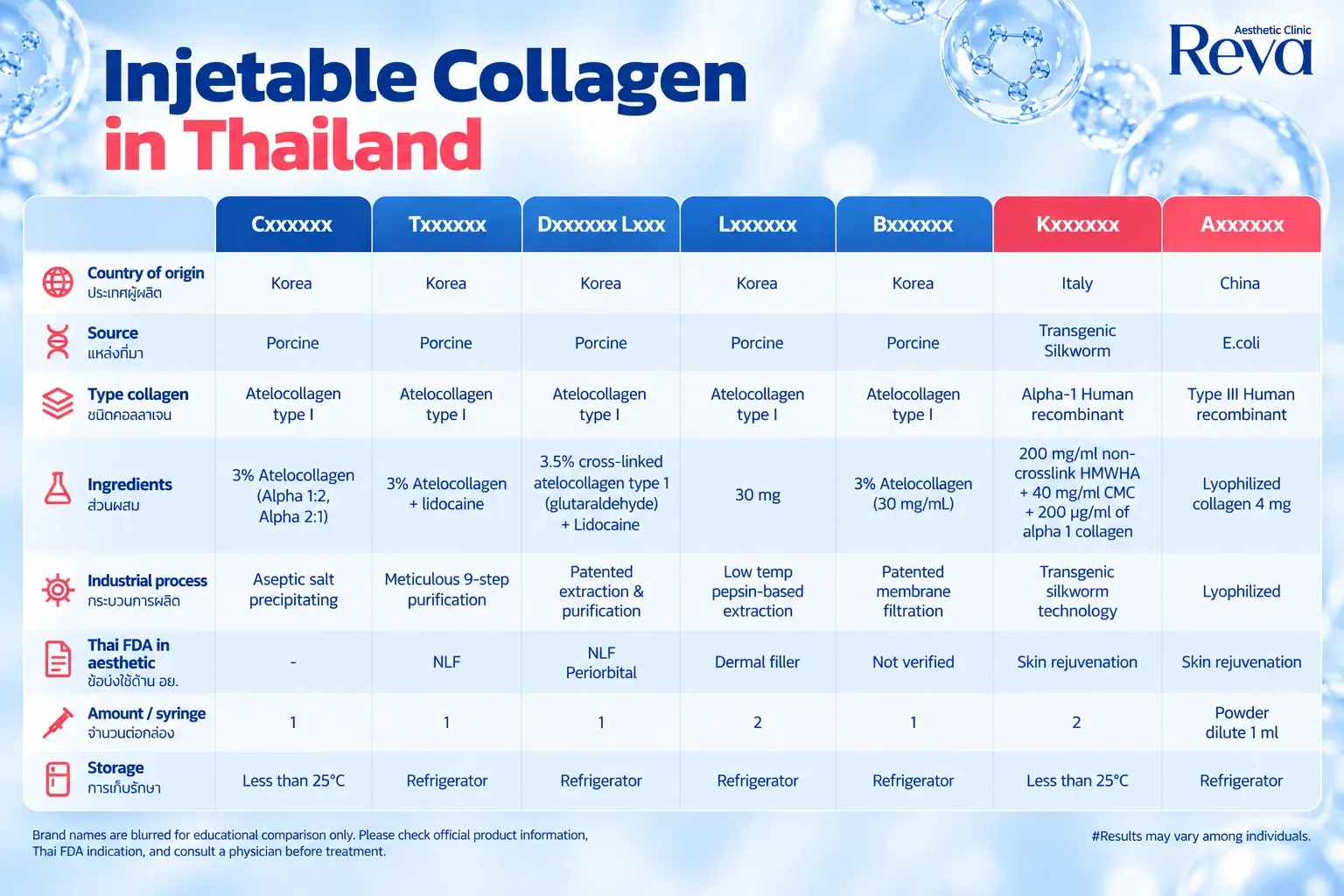
Several injectable collagen products are currently available in Thailand. Although they are commonly referred to as “injectable collagen,” each product may differ in its source, collagen type, ingredients, manufacturing process, and approved indications.
The table below compares selected injectable collagen products available in Thailand, highlighting their key differences and explaining why these products are not necessarily interchangeable.
Note: This table presents selected examples and does not include every injectable collagen product available in Thailand. Product information and approved indications should be verified against official product documentation and relevant regulatory approvals before clinical use.
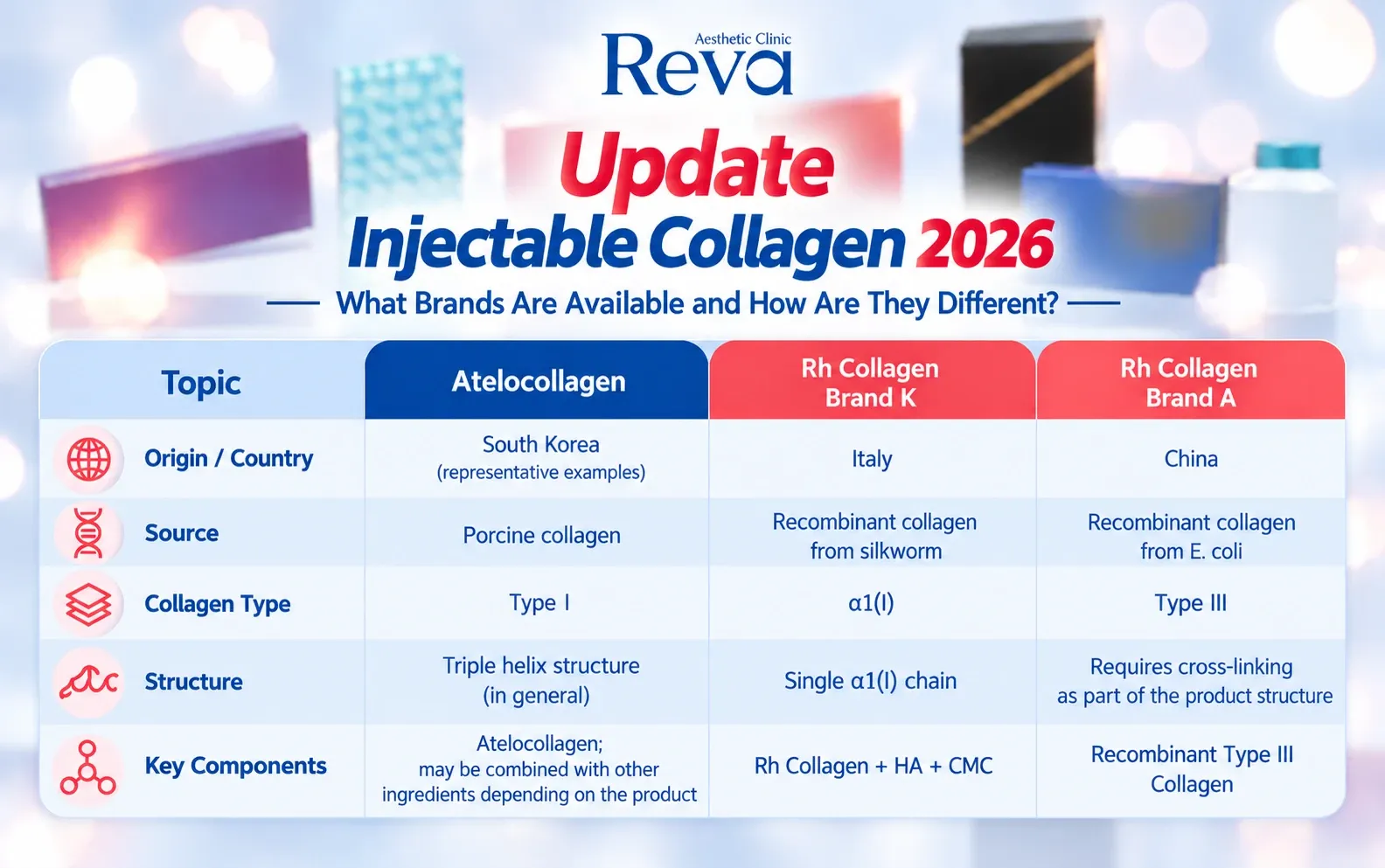
Injectable Collagen Comparison: Atelocollagen vs Rh Collagen
This table presents representative product categories rather than every injectable collagen brand available in Thailand. Product composition, molecular structure, and approved indications should be confirmed using current manufacturer documentation and Thai FDA records.
The comparison demonstrates why injectable collagen products should not be evaluated solely by their collagen type or country of origin.
In particular, clinical or laboratory findings involving Brand K's combination of recombinant collagen, HA, and CMC should not automatically be applied to other recombinant collagen products.
Atelocollagen vs Rh Collagen: Which Is Better?
This is one of the most frequently asked questions about injectable collagen.
Atelocollagen and recombinant collagen have different characteristics, but neither category has been established as universally superior.
Atelocollagen is notable for its retained triple-helix structure and emerging research involving collagen synthesis, GlyT1, and fibroblast-related pathways.
Rh Collagen (Karisma Program) is notable for its combination of recombinant α1(I) collagen, HA, and CMC. The formulation includes ingredients with different functions, including hydration and gel-related properties.
Rh Collagen (Ayouth program) uses recombinant Type III collagen, representing another approach to collagen-based injectable materials.
Nevertheless, there is currently insufficient direct comparative clinical evidence to conclude that one category consistently produces better results than the others.
A triple-helix structure does not automatically guarantee better outcomes than a single-chain recombinant protein.
Similarly, the use of Type I or Type III collagen alone does not determine a product's effectiveness.
Treatment selection should consider the complete formulation, clinical evidence, approved indications, injection area, and individual skin concerns.
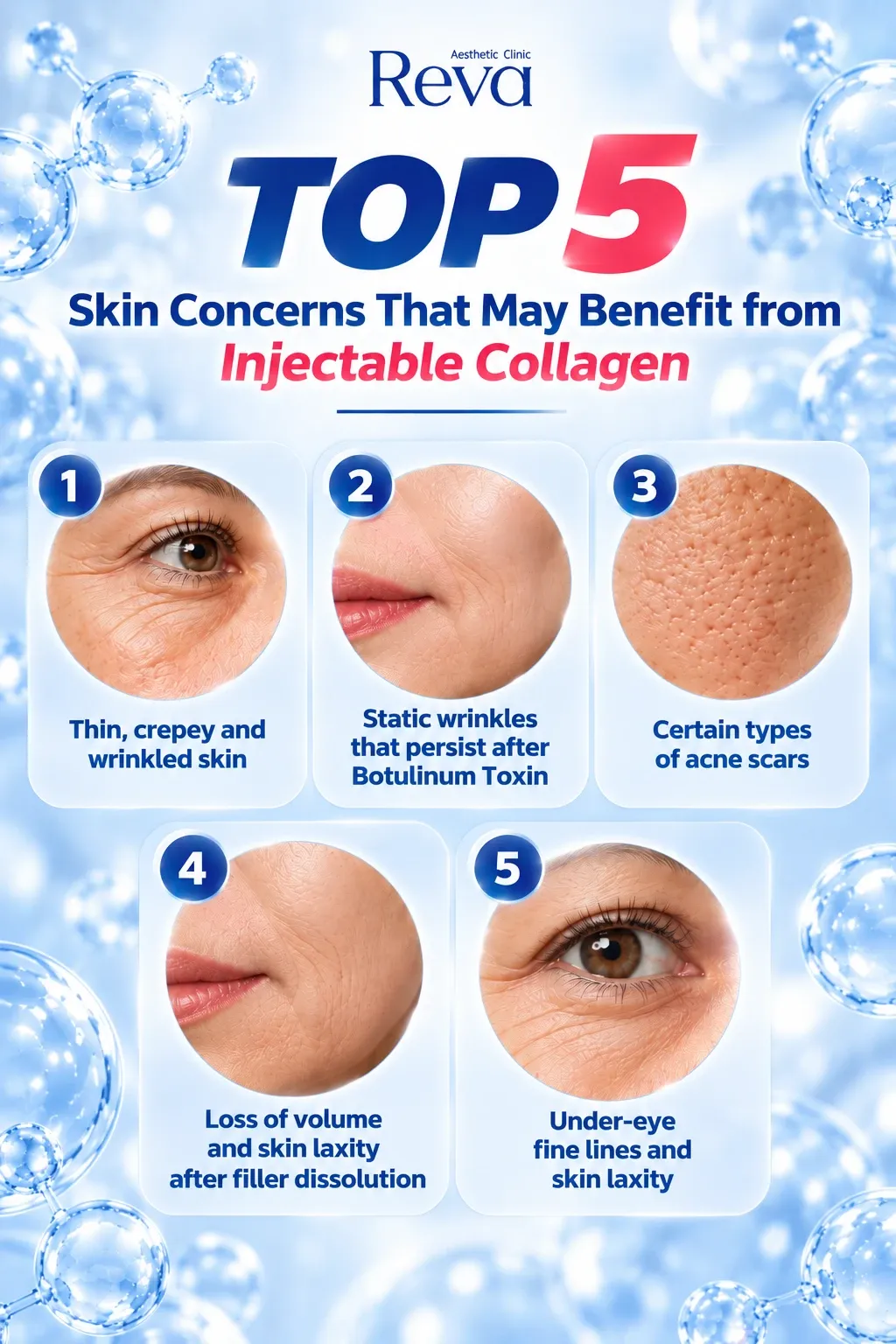
TOP 5 Skin Concerns That May Benefit from Injectable Collagen
Certain injectable collagen formulations may be considered for selected skin concerns, particularly when the goal is not simply to increase facial volume.
1. Thin, Crepey, Wrinkled, and Sagging-Looking Skin
As skin ages, it may become thinner, less firm, and more prone to fine wrinkles.
Some collagen-based injectables have been studied for improving the appearance of fine lines and skin texture.
Their suitability depends on the specific product and the underlying cause of the skin changes.
2. Persistent Wrinkles That Botox Cannot Fully Correct
Some wrinkles remain visible even when facial muscles are relaxed.
These are commonly called static wrinkles.
Botulinum toxin reduces muscle activity but may not completely eliminate wrinkles that are already visible at rest.
In selected cases, injectable collagen formulations may be considered as part of a treatment approach targeting superficial wrinkles, depending on their approved indications.
3. Certain Types of Acne Scars
Acne scars vary in depth, shape, and the extent of underlying tissue tethering.
Some collagen-based injectable products may help address selected depressed scars through their filling properties.
However, injectable collagen is not suitable for every type of acne scar.
Tethered scars, for example, may require treatments such as subcision or other procedures.
4. Skin Concerns After Filler Dissolving
After hyaluronic acid filler is dissolved, some individuals notice reduced volume, fine wrinkles, or uneven-looking skin.
This does not necessarily mean that the dissolving procedure has permanently damaged their natural collagen.
In some cases, the changes reflect the removal of volume that previously concealed underlying skin concerns.
Following appropriate assessment, additional skin-focused treatments may be considered.
However, direct clinical evidence supporting injectable collagen specifically for post-filler-dissolving skin concerns remains limited.
5. Thin, Crepey Skin Under the Eyes
The under-eye area has relatively thin skin and can develop fine wrinkles as elasticity decreases.
Some injectable collagen formulations have been investigated or used for selected periorbital concerns.
However, the under-eye region requires particular caution because injections may cause swelling, irregularities, nodules, or serious vascular complications.
Not every injectable collagen product is appropriate for this area.
These five concerns represent situations in which injectable collagen may be considered, not proven indications for every product.
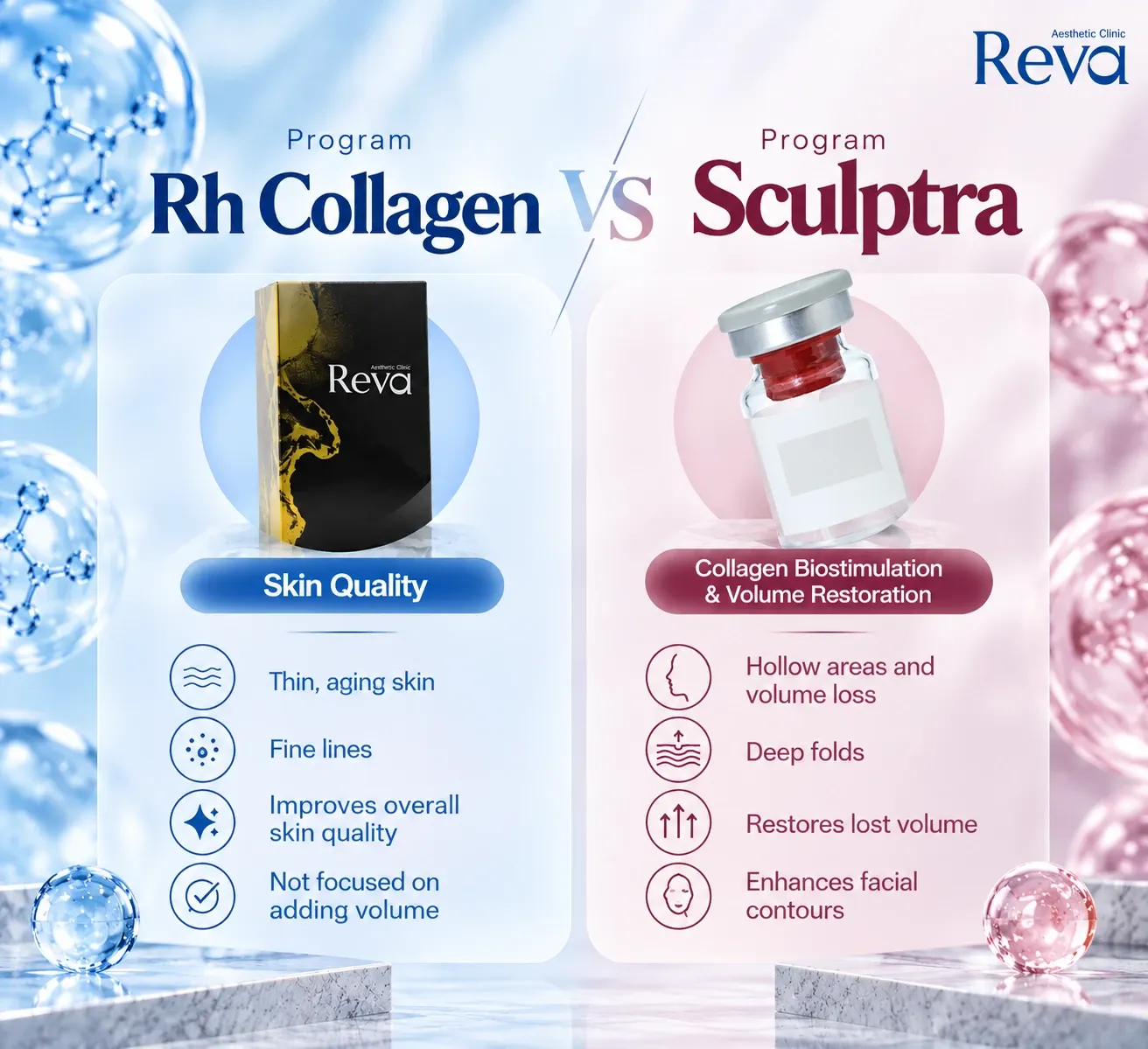
Injectable Collagen vs Sculptra: What Is the Difference?
Injectable collagen and collagen biostimulators are often discussed together, but they are not the same type of treatment.
Injectable collagen products contain collagen proteins or collagen-related materials.
In contrast, Program Sculptra contains poly-L-lactic acid (PLLA), a biostimulatory material studied for its ability to induce collagen formation through tissue responses.
Both approaches may be relevant to age-related skin concerns, but their compositions and mechanisms differ.
For example, a patient who has previously received Program Sculptra may still experience fine wrinkles or crepey skin.
This does not automatically mean additional injectable collagen is necessary.
A medical assessment is needed to determine whether the remaining concern involves superficial skin changes, tissue laxity, or facial volume loss.
Is Injectable Collagen Safe?
Injectable collagen treatments carry potential risks, as do other injectable aesthetic procedures.
Possible adverse effects include swelling, redness, bruising, pain, nodules, allergic reactions, and infection.
Serious vascular complications may also occur if a product is inadvertently injected into a blood vessel.
Although removing telopeptides from animal-derived collagen can reduce immunogenicity, it does not eliminate the possibility of allergic reactions.
Likewise, recombinant collagen products require safety evaluation of the entire formulation, including additional ingredients and manufacturing-related factors.
Unlike hyaluronic acid fillers, collagen-based injectable products do not have an equivalent widely established enzymatic reversal method.
For these reasons, product selection, appropriate injection technique, anatomical knowledge, and medical assessment are essential.
Conclusion: Which Injectable Collagen Should You Choose in 2026?
The most important development in injectable collagen in 2026 is the growing diversity of products.
Animal-derived Atelocollagen and Human Recombinant Collagen differ in their protein structures, manufacturing processes, and formulations.
Some products contain collagen as their primary ingredient, while others combine recombinant collagen with hyaluronic acid and additional gel components.
Although emerging research provides insights into fibroblast activity and collagen-related pathways, direct clinical evidence comparing these products remains limited.
The best injectable collagen treatment should be selected according to the patient's skin concerns, rather than the collagen type or brand name alone.
Program Rh Collagen at REVA Clinic
At REVA Clinic, treatment planning begins with an assessment of the underlying causes of skin concerns, including fine wrinkles, changes in skin firmness, facial volume loss, and skin laxity.
For patients interested in Program Rh Collagen, our physicians evaluate skin condition, previous treatments, and product suitability before recommending an individualized treatment plan.
Learn more about Program Rh Collagen at REVA Clinic.
Frequently Asked Questions About Injectable Collagen
Which injectable collagen brand is best?
There is no single best product for everyone. The choice depends on the product's formulation, approved indications, clinical evidence, and the patient's skin concerns.
What is the difference between porcine collagen and silkworm-derived recombinant collagen?
Porcine Atelocollagen is extracted and purified from animal connective tissue. Silkworm-based recombinant collagen is produced through biotechnology using genetically modified silkworms. Their sources and manufacturing methods are different.
Is Type I or Type III recombinant collagen better?
There is insufficient comparative clinical evidence to establish that one type is generally superior. The actual molecular structure and formulation of each product also matter.
No. Injected collagen is not automatically transformed into newly synthesized collagen. Its biological effects depend on the formulation and how the material interacts with surrounding tissues.
Can injectable collagen be used under the eyes?
Only when appropriate for the specific product and patient. The under-eye area requires careful assessment, and not every injectable collagen formulation is suitable for periorbital injection.
References
Byun KA, et al. Atelocollagen Increases Collagen Synthesis by Promoting Glycine Transporter 1 in Aged Mouse Skin. International Journal of Molecular Sciences. 2025;26(24):11825. https://doi.org/10.3390/ijms262411825
Augello FR, et al. Evaluation of the Effectiveness of an Innovative Polycomponent Formulation on Adult and Aged Human Dermal Fibroblasts. Biomedicines. 2023. https://pmc.ncbi.nlm.nih.gov/articles/PMC10525616/
Di Rosa L, et al. New Regenerative and Anti-Aging Medicine Approach Based on Single-Stranded Alpha-1 Collagen for Neo-Collagenesis Induction. Biomedicines. 2024;12(4):916. https://doi.org/10.3390/biomedicines12040916
Varani J, et al. Decreased Collagen Production in Chronologically Aged Skin: Roles of Age-Dependent Alteration in Fibroblast Function and Defective Mechanical Stimulation. American Journal of Pathology. 2006;168(6):1861–1868. https://doi.org/10.2353/ajpath.2006.051302
An Update on the Clinical Efficacy and Safety of Collagen Injectables for Aesthetic and Regenerative Medicine Applications. Polymers. 2023;15(4):1020. https://doi.org/10.3390/polym15041020
This article is intended for medical education and does not constitute individualized treatment advice. Clinical outcomes and approved indications vary by product and require assessment by a qualified physician.