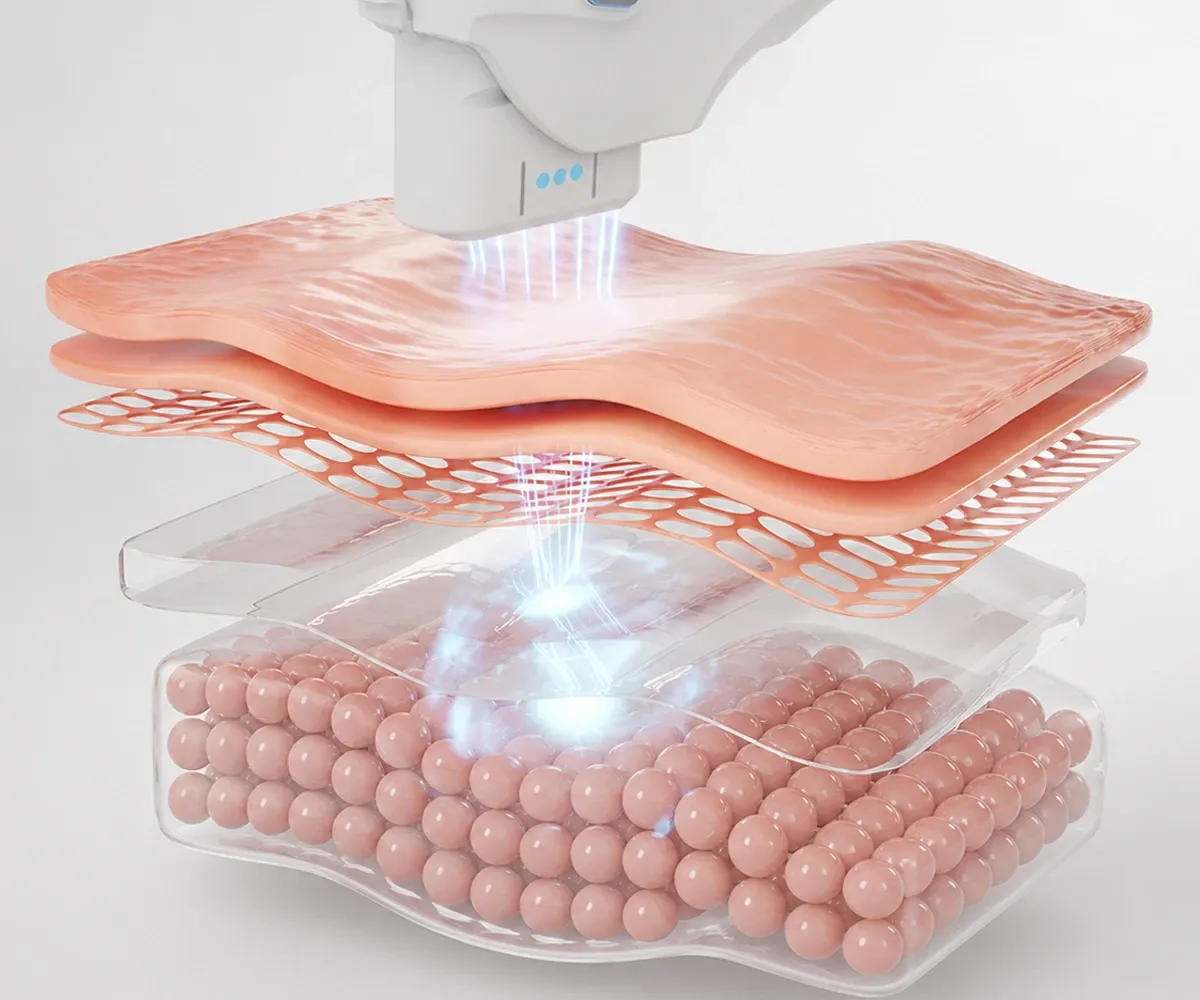
Program Ultraformer MPT and Program Ulthera are both ultrasound-based treatments used for non-surgical skin tightening and lifting. Although they are often compared as similar treatments, there are important differences in treatment depth, tissue visualization, and energy delivery.
At Reva Clinic, the choice between the two does not begin with which device is more expensive or how many lines or shots are used. The more important question is:
Where is the target tissue, and which technology can deliver energy to the appropriate depth for that individual anatomy?
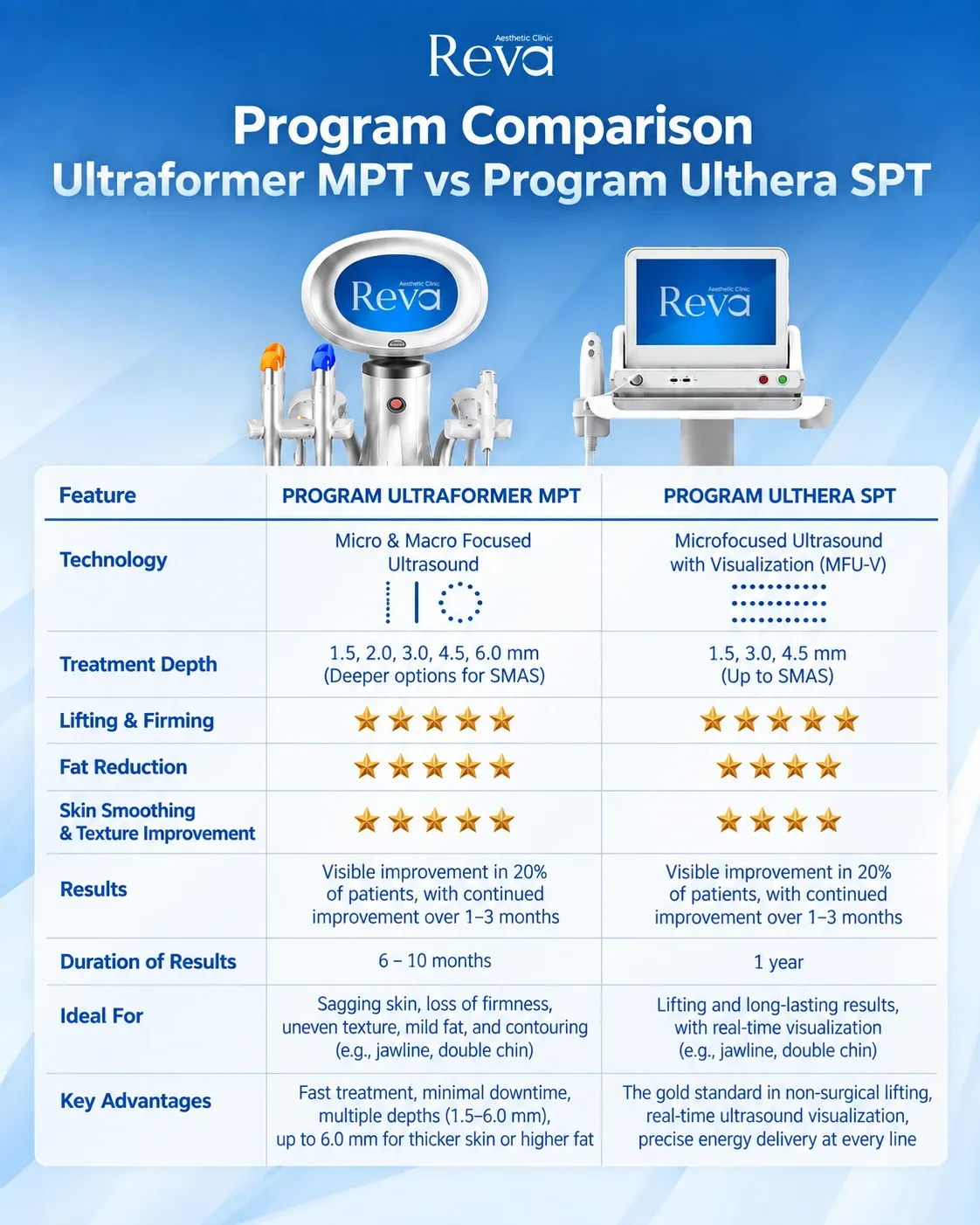
Program Ulthera uses Microfocused Ultrasound with Visualization (MFU-V). One of its defining features is real-time ultrasound imaging, which allows the physician to visualize tissue layers during treatment.
Program Ultraformer MPT uses Micro & Macro Focused Ultrasound and offers a broader range of cartridges at different focal depths. According to the manufacturer, available focal depths include 1.5, 2.0, 3.0, 4.5 and 6.0 mm, with deeper cartridges available for specific treatment areas and indications.
This difference can become clinically relevant because facial anatomy and subcutaneous tissue thickness vary considerably from one person to another.
Why Does Treatment Depth Matter?
The 4.5 mm transducer is commonly associated with treatment of deeper facial tissue, including the SMAS in anatomically appropriate areas.
However, the SMAS and other target tissue layers are not located at exactly 4.5 mm in every patient or every area of the face.
Skin thickness, subcutaneous fat and the position of deeper structures vary between individuals. Importantly, these differences cannot always be accurately determined simply by looking at the face or by physical examination alone.
In our clinical experience at Reva Clinic, ultrasound assessment sometimes reveals that patients with thicker subcutaneous tissue have target structures located deeper than expected in certain areas.
This is why we do not assume that a 4.5 mm treatment depth is automatically appropriate for every face.
A Limitation of Program Ulthera: Maximum Treatment Depth of 4.5 mm
Program Ulthera provides treatment transducers at 1.5, 3.0 and 4.5 mm.
Its visualization system can image tissue deeper than its maximum treatment depth. This distinction is important:
Imaging depth and treatment depth are not the same thing.
Real-time ultrasound may show that the intended target tissue lies appropriately within the depth reached by a 4.5 mm transducer.
However, in some patients—particularly in areas with thicker subcutaneous tissue—the ultrasound assessment may show that the tissue the physician intends to treat lies deeper than 4.5 mm.
In such cases, the limitation is not the ability to see the tissue. The limitation is that the deepest Program Ulthera treatment transducer is 4.5 mm.
One difference with Program Ultraformer MPT is the availability of additional focal depths.
Alongside 1.5, 2.0, 3.0 and 4.5 mm cartridges, Program Ultraformer MPT also offers a 6.0 mm cartridge, providing another treatment-depth option when clinically appropriate.
This can be useful when assessment suggests that the intended target tissue in a particular area lies deeper than the level that can be reached with a 4.5 mm transducer.
However, deeper does not automatically mean better.
A patient with a thin face, limited subcutaneous fat or a more superficial target layer may have no indication for treatment at 6.0 mm. Treatment depth should therefore be selected according to anatomy and the treatment objective rather than simply choosing the deepest cartridge available.
The Key Advantage of Program Ulthera: Real-Time Ultrasound Visualization
While Program Ulthera has a maximum treatment focal depth of 4.5 mm, one of its major advantages is real-time ultrasound visualization.
The MFU-V system allows the physician to visualize the tissue beneath the skin and assess the layers being treated. This provides additional anatomical information when selecting the transducer and designing the treatment.
This is particularly relevant because two patients with similar facial appearances can have different tissue thicknesses beneath the skin.
At Reva Clinic, ultrasound is therefore not used simply to confirm that a 4.5 mm transducer can be used. In some cases, visualization can also reveal that 4.5 mm may not correspond to the intended target depth in a particular area.
The ultrasound findings can then become part of the decision about treatment depth and device selection.
Another Strength of Program Ulthera: Thermal Coagulation Point Consistency
Another area in which Program Ulthera has published data is the formation of Thermal Coagulation Points (TCPs).
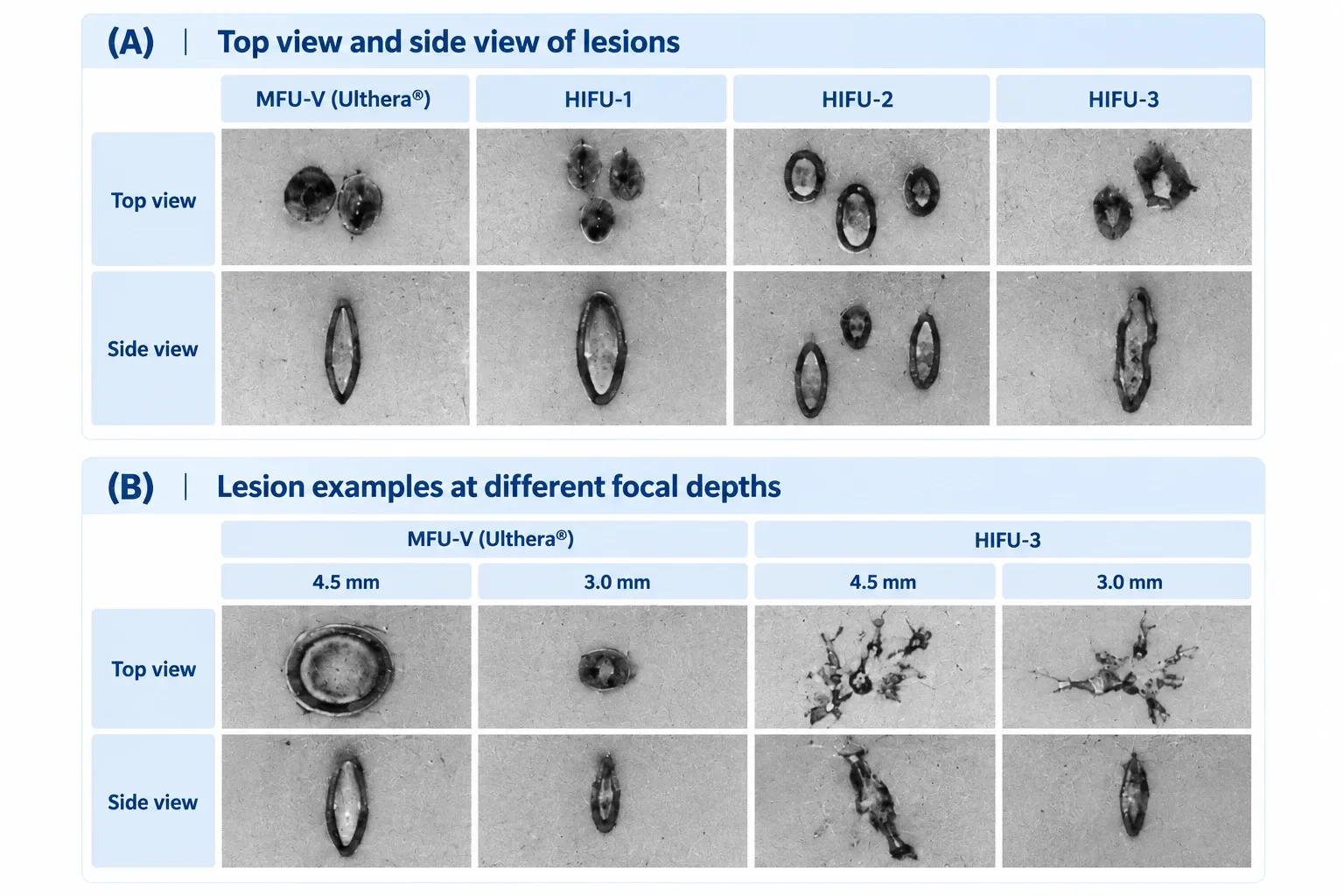
A 2022 study by Pavicic and colleagues evaluated four ultrasound systems, including Ultherapy (MFU-V), Ultraformer III and two other HIFU devices. The investigators assessed thermal characteristics, transducer acoustics and ultrasound therapy characteristics.
In the experimental testing, MFU-V demonstrated relatively consistent TCP size and shape, precise localization of energy at the focal point, and controlled thermal characteristics. The authors highlighted a combination of properties including TCP uniformity, tight thermal regulation, large focal gain and short beam length.
Figure caption:
Comparison of Thermal Coagulation Points (TCPs) produced by different ultrasound systems in tissue-mimicking material, shown from top and side views. In this study, HIFU-2 represents Ultraformer III, not the current Ultraformer MPT. The findings therefore should not be interpreted as a direct comparison between Program Ulthera and Program Ultraformer MPT.
Reference:
Pavicic T, Ballard JR, Bykovskaya T, et al. Microfocused ultrasound with visualization: Consensus on safety and review of energy-based devices. Journal of Cosmetic Dermatology. 2022;21(2):636–647. doi:10.1111/jocd.14666.
This distinction is important. The study provides useful evidence regarding the energy characteristics of the MFU-V system, but because the comparator was Ultraformer III rather than Ultraformer MPT, it cannot establish that Program Ulthera produces more consistent TCPs than the current Program Ultraformer MPT.
The two technologies therefore offer different advantages rather than simply representing a “better” and “worse” version of the same treatment.
Program Ulthera: Visualization + Precision
Program Ultraformer MPT: Flexibility of Treatment Depth
The clinical value of either advantage depends on the patient's anatomy.
Choosing between the two should not be based solely on the device name, price, number of lines or maximum treatment depth.
At Reva Clinic, the approach is:
Facial Assessment → Tissue Assessment → Target Depth → Treatment Design → Device Selection
When the target tissue lies within the treatment range of Program Ulthera, real-time ultrasound visualization can provide valuable information for individualized treatment planning.
On the other hand, when assessment indicates that the intended target tissue in a particular area lies deeper than 4.5 mm, the broader range of treatment depths available with Program Ultraformer MPT—including the 6.0 mm cartridge—may provide another option for the physician to consider.
For this reason, one patient may be more appropriately treated with Program Ulthera, while another may benefit from the additional depth flexibility of Program Ultraformer MPT. In some treatment plans, different depths or technologies may also be considered for different anatomical areas.
The Reva Clinic Approach: Choose the Target Before the Device
The difference between Program Ultraformer MPT and Program Ulthera cannot be reduced to which device is “better.”
Program Ulthera offers real-time ultrasound visualization and has published experimental evidence supporting the consistency and focal characteristics of its MFU-V energy delivery.
Program Ultraformer MPT provides a broader range of treatment depths, including 6.0 mm, which may be useful when the intended target tissue lies deeper than 4.5 mm.
At Reva Clinic, we therefore do not estimate treatment depth simply from how full or thin the face appears from the outside.
The more relevant question is:
Where is the tissue we want to treat, and which technology allows us to target that layer appropriately?
This anatomy-based approach is why two patients with apparently similar facial concerns may receive different treatment designs.